
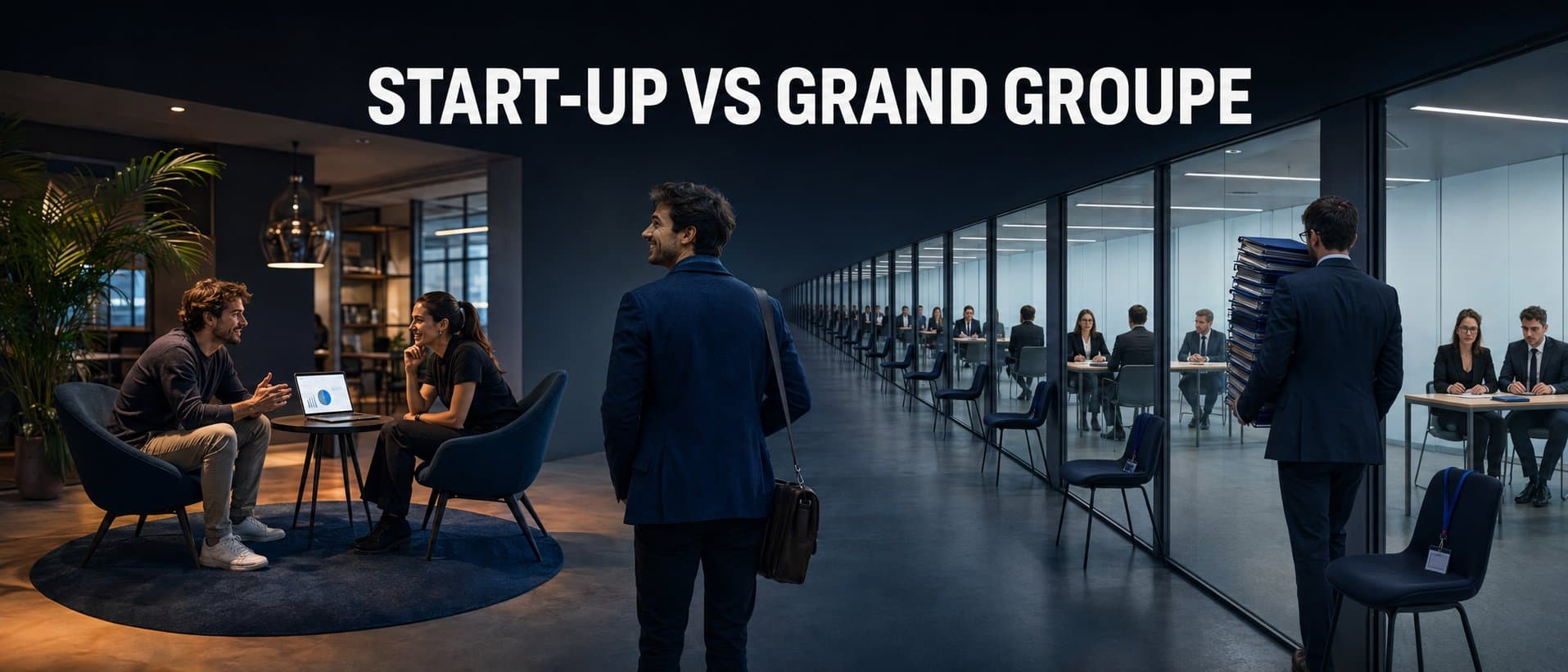
A startup or scale-up interview process often has little in common with a large company's: fewer formal stages, but a bar for fit and evidence that can surprise candidates used to more standardized processes.
The typical stages
An initial scoping call, often with the recruiter or founder: company culture, business challenges, non-negotiable criteria for the role.
One or more interviews with the team or direct manager, focused on concrete evidence rather than a general pitch, STAR method, backed by numbers.
A case study or role-play exercise, common for Sales and Tech roles: a mock sales call, a sourcing strategy presentation, a technical exercise.
A closing interview, often with a leader, to confirm final alignment and answer the candidate's last questions.
What differs from a large company
Fewer levels of hierarchy to convince, but far less tolerance for approximation: at a startup, every hire counts double, and the absence of heavy HR process is often offset by a stronger individual bar at every stage.
Three missions, three different processes
Ringover (cloud scale-up, embedded RPO over 3 years): a dedicated pipeline per country and level, from SDR to VP Sales, with every candidate personally interviewed by Walid before being presented to the team, a qualitative filter never delegated to sourcing alone, despite the volume.
Voodoo (mobile gaming studio, rare profiles): deliberately very high selectivity, roughly 2,000 candidates sourced for 40 hires across the whole mission, a 0.15% conversion rate that reflects a tight filter, not a lack of sourcing volume.
Malt (freelance marketplace, 7 Key Account Managers in 2.5 months): an interview funnel tracked stage by stage, with precise conversion rates (75% between R1 and R2, 40% between R2 and R3, 70% between R3 and R4), real selectivity often plays out in the middle stages, not the first screen.
How to handle this process well as a candidate
Prepare concrete evidence rather than a general pitch, accept that a short process doesn't mean a lax one, and ask precise questions about what will be evaluated at each stage, a serious recruiter can always answer that question.